


 Posts
Posts


Amazing to see so many people offer to save a child prenatally diagnosed with Down syndrome. If only more families would offer their baby up for adoption, as there are hundreds of families waiting to adopt a baby with DS.
Of course there will be negativity to this also, as I saw one article that was totally hating on the idea of saving a baby with Down syndrome from an abortion. So sickening. Reminds me of this song.
Hundreds call to adopt Down syndrome baby, save it from abortion
When the Rev. Thomas Vander Woude learned about a young couple planning to abort their unborn baby that had been diagnosed with Down syndrome, the priest reached out and offered a deal: Deliver the child and he would help find an appropriate adoptive family.
But he had to act fast.
The woman, who has not been identified for her privacy and her protection, was just shy of six months pregnant and lives in a state that prohibits abortions past 24 weeks — which meant he had a short time to find a family willing to make a lifelong commitment.
So Father Vander Woude, the lead pastor at Holy Trinity Catholic Church in Gainesville, Va., approached a volunteer who helped manage the church’s social media pages, and she posted an urgent plea on Facebook early Monday morning.
“There is a couple in another state who have contacted an adoption agency looking for a family to adopt their Down Syndrome unborn baby. If a couple has not been found by today they plan to abort the baby. If you are interested in adopting this baby please contact Fr. VW IMMEDIATELY,” the post read. “We are asking all to pray for this baby and the wisdom that this couple realize the importance of human life and do not abort this beautiful gift from God.”
The post asked people to call the church’s office after 9:30 a.m. Monday or to email Father Vander Woude.
No one expected the response they received.
“When we got in and opened up around 9:30, it was nearly nonstop. All day long, we were receiving phone calls from people who wanted to adopt the baby,” church staff member Martha Drennan said. “Father Vander Woude has gotten over 900 emails in regard to the baby.”
The offers were narrowed to three families, which the unborn child’s parents are reviewing with the help of an adoption agency.
Ms. Drennan said the church received phone calls from all over the United States and around the world, including from England, Puerto Rico and the Netherlands.
“I think it is a wonderful use of social media, that word can so quickly get all over the country and even to foreign countries and that the people who see the value of life are stepping up and saying, ‘I will take that baby and raise that baby as mine,’” Ms. Drennan said. “It was a beautiful witness all day long that so many people wanted this child and believed in the dignity of that child — Down syndrome or not.”
The president and founder of the International Down Syndrome Coalition, Diane Grover, stressed the importance of informing couples who are considering abortion for babies with Down syndrome that adoption is a viable option, pointing to the fast and overwhelming response her organization received about this one unborn child as an amazing example.
“When [couples are] in that position, a lot of people wonder if their child [with Down syndrome] would actually get adopted,” Ms. Grover said. “There’s a lot of people waiting, and we are happy to always help.”
David Dufresne, a seminary student who plans to become a priest next year, volunteered to help the overwhelmed church staff take calls.
“I was taking calls for about three hours straight, just talking to people who are willing to adopt this little baby they never knew about until that morning,” Mr. Dufresne said. “I mean, all day long, just receiving phone calls from people who were so generous and within a couple minutes made a life-changing decision. I was really inspired by the goodness of people and what they would do to save a life.”

Tweet
Thursday, July 11, 2013
Hundreds Offer To Adopt Baby With Down Syndrome To Save It From Abortion

Saturday, October 16, 2010
31 for 21: She Died An Orphan.

This little girl just recently passed away.
She died an orphan, just because she had something different in her genetic makeup.
She lived most of her life in a crib with hardly any stimulation.
On the days she was brought outside, she was kept in a stroller or crib.
She had a heart murmur that would've needed correction sooner than later.
Because of that, the nurses & doctors thought she was even worth "less." That she shouldn't have been adopted.
A family never came for her, although many people advocated and raised money for her adoption grant.
And so, at the young age of barely 5 years old, she died. Died abandoned. Just because she was "imperfect."
I can't even begin to imagine someone giving their child up to an orphanage because they are "different."
This little girl was just a few months younger than Osiyyah. That really puts things into perspective.
I know how much Osiyyah can do. I know how much he understands. I know how normal of a life he lives. I know how healthy he is, all by God's kindness. I know how he can interact with people in daily life. I know how active he is. I know how motivated he is. I know how much he has thrived.
All because God was extremely merciful to him & us and he was born into a family that loved him just as much as any other child, even though he has a little something extra.
To see a 5 year old child kept in a crib most of her life? Unimaginable. Unthinkable that someone could do that.
And that's the way this poor little girl died. She died as a 5 year old orphan who spent most of her day in a crib.
Sad. Sad. Sad. I have to hold back the tears as type this post up.
This gives me comfort though: "The Lord executes righteousness and justice for all who are oppressed." (Psalm 103:6)

Sunday, October 10, 2010
31 for 21: The Lost Boys...A Mental Institute
The Nalles family recently completed the adoption of Aaron, a little boy with arthrogrypsis, who lived in a mental instutition in the Ukraine. Most of the time, once a child is transferred to a mental institute (aka internat), there is little hope of adoption, little hope of finding a family.

Aaron was the first child to be adopted out of this internat. Because of that, his family had may obstacles to face and a very hesitant judge (which you can read about on their blog). But, hopefully, because of what the Nalles went through, more children will be available for adoption from this internat.
Out of the many boys who are where Aaron used to live, only 2 others are available for adoption. The rest of the boys will live out their lives in the sad grounds of a mental institution, before they age out of that place (at 18) and are transferred to an even worse place - an adult mental institute. Simply because they were born "imperfect", were rejected by their society and left by their families.
The Nalles wrote about what they saw at the internat in one of their blog posts. I'll quote it here:
Every morning while we visit Aaron, we see the Lost Boys moving around the internat grounds in their groups on their way to and from snack time. A few are in wheelchairs, the older boys pushing the younger ones. The rest all hold hands in pairs so that no one gets lost. The caretakers always keep gentle hold on three or four. Together, they make a strange and awkward procession. At first it was a bit frightening because there are so many of them, and most of them make some strange noise or awkward movement. Now we’re used to them, and we look for the ones we recognize every day: The one who smiles with uncontainable glee every time we look at him. The one who dances with reckless joy whenever the radio plays. The serious one who sometimes says “Mama.” The legless older boy in the wheelchair who never makes a sound, but always grins when we wave. The troublemaker who tore the bed off of Aaron’s dump truck on our first trip. Each of them has his own likes and dislikes, his own personality. Most of them will never know any other life than the one they have now.
It is a harsh life. Some of the older boys have jobs setting tables, carrying laundry or emptying trash bins. These make the most of their bit of freedom. The rest have little to do but sit on benches or on the ground, rocking back and forth hour after hour, day after day. Some wander around within their group’s play area. Those who are able sometimes kick a ball or push a wheelchair around. They have no other toys, nor do they receive any teaching, therapy or stimulation. It is a great honor for us to be allowed to bring Aaron out of such a place.
We have counted over 60 boys marching by for their snacks. Inside the buildings in the back are even more boys, the bedridden ones who seldom see the light of day. We have had only glimpses of one or two of these, but what we have seen we will never forget-- a child with a deathly white face, so stiff that his waist never bent as two nurses carried him to an ambulance, one at his shoulders, the other at his feet.
The internat staff makes the best of its limited resources. For the outdoor boys, there are usually one or two caretakers in charge of 20-25 mentally disabled boys ages 5 to 18. They care for the boys, but they can do little more than keep the peace in such large groups of needy kids. They are overworked and overwhelmed just maintaining cleanliness and order. We admire them for the care they show for the Lost Boys.
The Lost Boys arrive at this internat when they are five years old, transferred from the baby houses where they have lived since their parents gave them up. Frightened and friendless, they are torn from the only world they have ever known. They have failed the tests that would have entitled them to receive an education. Their mental or physical disabilities mean that they are unqualified to live outside the internat. With no stimulation, there is little chance that they will improve. Unless they die first, they will remain at the internat until they turn 18. Then they will be transferred for the last time, to an adult mental institute where they will live out the rest of their lives. This is their sad reality. Aaron is the first child ever to leave this internat. When he walks out of its gates, he will break its sad cycle for the first time.
Part of our hearts will break when we, too, leave the Lost Boys behind. Only two or three of them have any hope for a family as things now stand. They are available for adoption, but time is running out for them, and unless someone claims them soon they’ll be as lost as the older boys already are. How they would blossom if they got the chance! As unreachable as most of the Lost Boys seem, there isn’t one of them who wouldn’t improve with some stimulation. But these younger ones need someone right now, before they’re lost in the system forever.
And, so, as I've said before, the only way we can continue to go on with knowing the horrible stuff that goes on in the world, is that one day God will come back and bring justice to this earth.
Tuesday, October 5, 2010
31 for 21: Reece's Rainbow's Yulia
Reece's Rainbow provides awareness about the plight of orphans with special needs in so many countries. Over the last few years since RR has been in existence, 130 children have come home to their forever families. And there are MANY more children whose families are in the process of bringing them home.
Yet, it remains a shame that the governments have set up so many obstacles and requirements for families who would like to adopt. There are countless orphans in orphanages and institutions in the world, but the governments are more concerned about seeing if the family is "qualified to parent" these children, than just bringing them home.
Now, don't get me wrong, I completely understand why these requirements are there. Because there are jerks who would not be bringing home these children for the best interest of the child. But, it is sad, that because of those kinds of people, there have to be all these rules, which make it so much harder for those who actually are adopting for the love of the child and in the best interest of the child.
So, because of these rules and requirements, international adoption in particular is crazily expensive. Many families who are adopting have to do a lot of fundraising to be able to pay the expenses.
Over the years of watching various blogs in the RR adoption world and group, I've seen several amazing fundraisers.
Last November, an 11 year old girl named Lydia, asked her mom if she could raise $20K by Thanksgiving (8 days), if they would bring home a little girl from the Ukraine named Darya. Her mom said yes. And so, by Thanksgiving, Lydia had raised $28,500. She did a lot in those 8 days to raise the money and she did it! It was simply amazing.
Lydia's family ended up not being able to bring Darya home for various reasons, but because Lydia was able to raise $28K, Darya's family is currently in her country completing the adoption process.
This past week another family decided to raise awareness about a little 2 year old girl, Yulia, in Eastern Europe.

Yulia has a very rare syndrome called Cockayne Syndrome, which causes premature aging, impaired development and so on. Typically these children die at a young age. Yulia is in an orphanage where she is left in a crib most of the time, rarely taken out to see the light of day. And so, this family, decided to advocate for Yulia to get a sizeable grant available for her adoption. They gave away an Apple iPad and within 5 days had raised $20,000 for Yulia's adoption grant.
Now, all Yulia is waiting for, is a family, as her adoption is almost fully funded.
Saturday, September 25, 2010
CTR in The Ukraine
Connecting the Rainbow is on their first trip to the Ukraine to establish connections with families, doctors, therapists, and orphanages in various regions of Ukraine.
It was just a short trip (a few days), but you can see the details of their trip at the Connecting The Rainbow blog.
Shelley (adopted kids through RR from Ukraine, Serbia & Bulgaria) & Meredith (adopted 2 through RR from Ukraine in 2008 & is in the process of adopting another one from EE) went on this trip together. One of the main reasons they went was because of the DownsEd conference that was held in Kiev, Ukraine.
But, since they were on this trip, they were able to visit several orphanages (including the one Meredith's 2 kiddos came from), a therapy center that recently opened, a maternity hospital and more.
Hopefully this will help open the gateway for more connections in Ukraine and bring hope to families there, so that someday orphanages and institutions will be a thing of the past.
Tuesday, September 21, 2010
Reece's Rainbow Canada
Reece's Rainbow has now opened up a program for families in Canada to adopt "through" them. The director for RRC is Shannon Stepanek, instead of Andrea Roberts who is the director for RR. Hopefully this will help a lot more orphans find families!

Click here to go to the RRC website.
Thursday, September 9, 2010
So Sad.
This little girl had Cerebral Palsy in Eastern Europe.
Because of that, she was left in an orphanage . . .
...To be hidden away from the world and from a family
...To be taken care of just enough to live, but with minimal care, love & nutrition
...To spend her days in a crib

When she outgrew her time at the orphanage, she was transferred to a horrible mental institution in Eastern Europe.
Simply because she had Cerebral Palsy.
According to the mindset of many people in EE, she wasn't fit to be a part of society. Her life was destined to be hidden away. Tucked away in a crib in a dark orphanage and then quietly transferred to a place where many children die very shortly after coming.
And that's what happened to this little girl.
Just a few months after arriving at this horrible mental institution, she passed away. So sad.
Her days were spent hidden away from the eyes of the world, so that no one would have to deal with this child who may be a "burden to society."
But, there was One who knew all her days from the time she was born and that is God. I praise God that He will come soon and bring true justice to all.
Wednesday, September 8, 2010
Adoption Homecoming Video: This is Home
John & Charissa Urban (you can view their blog here) live just a few hours from us here in Oklahoma. A couple years ago they adopted Ava (who has Down syndrome) from the Ukraine. She was 4 years old and the size of an infant. She has since made tremendous progress.
This summer, the Urbans went back to the Ukraine to adopt Joseph, another little boy with Down syndrome and also Zoya, a little girl with other special needs.
Charissa put together a slideshow of Joseph's & Zoya's adoption. I thought it was very sweet and figured you all would enjoy it too.
Thursday, August 19, 2010
Connecting the Rainbow Heading to Ukraine
I've posted about Connecting the Rainbow a few times before. CTR is an off-shoot of Reece's Rainbow that is designed to educate families and professionals in Eastern European countries. Education is so important in EE countries, because families are not told the truth about raising a child with Down syndrome. They are told to put them into an institution or an orphanage. There are only a few families in these countries that actually keep their children with Down syndrome.
Actually, there was one family a few months ago, who, by the encouragement of RR, brought their child home out of the orphanage to live with them.
As I've posted about before, CTR has made a couple trips to Bulgaria to deliver resources and therapy items to families there. They will be going back to Bulgaria in March 2011 for World Down Syndrome Day for a 2-day conference.
Our book has made it to Bulgaria with CTR and to the families there. It also recently went with a family who was adopting from an orphanage in Ukraine to give to the director of the orphanage . . . he actually requested books on Down syndrome.
CTR has been working on ways to give more information, resources and therapy items to families in the Ukraine and Serbia. And just to educate the public there. Well, they have been given an amazing opportunity to attend the DownsEd International Down syndrome conference in Kiev, Ukraine!
Here's a bit of info that Shelley recently posted about the upcoming trip to Kiev:
In the midst of the beginning preparations for the CTR trip to Bulgaria next March, we were given an exciting opportunity to make face-to-face contact and really "open" our program in Ukraine!
Though the timing was a big unexpected (and fast!), the opportunity was too great to pass up. I, along with Reece's Rainbow's Ukraine coordinator, Meredith Cornish, will be attending the Down Syndrome conference in Kiev, Ukraine!!! We will have the opportunity to meet with birth families in Kiev, speak with leaders of the Down syndrome group to assess how we can best support the families and visit the new Down Syndrome Early Development Center. We are extremely blessed to have this opportunity for face-to-face meetings with the parents that are right now "in the trenches" in Ukraine, working to change the minds and hearts of their society about the value and potential of people with Down syndrome. Just like in Bulgaria, we know that meeting these families "where they are" is THE most effective way to truly understand their needs and to plan for the most effective way to partner with them and support them and their children.
In addition to the exciting things happening in Kiev, we've been given a 2nd opportunity to impact another area of Ukraine. Connecting The Rainbow will be partnering with another organization to assist in supporting a special needs center in the Donetsk region of Ukraine. The center is in the city of Artemovsk and will serve ALL children with special needs and their families in the community and surrounding areas. It will be a place for families to come for support, information, resources, etc. It will be a place for the children to receive therapy, to play with developmentally appropriate toys and to interact with other children. We are very excited about the opportunity to assist with this project as it will serve so many children with a variety of special needs. There are already over 190 families signed up to receive support from this facility!
So, there are a lot of exciting things happening in Ukraine! Connecting The Rainbow has been given incredible opportunities to partner with families in Ukraine and to assist them in providing for the needs of their children. We're currently in the process of compiling a list of items that will be needed for the special needs center in Artemovsk and also items that the families in Kiev want/need as well. We're looking forward to the opportunity to be able to visit both facilities, gather a lot of information and take lots of pictures to share with all of you!
Monday, July 19, 2010
The Castle
A few days ago I mentioned a story we have in our book that was written by Dave Hingsburger and I said I would post it up sometime here. So, here it is . . . Tissue warning on this :).
He was born at the wrong time to the right woman. 67 years ago Richard was born with Down Syndrome, his mother was informed moments after his birth that he was a defective child and should be sent to the 'Castle'. She decided then and there that no child of her's would grow up in Lennox Castle, the hospital for disabled children in her area. Doctors, unnerved at her determination to keep her child, young Richard, informed her that because he had Down Syndrome he would die young that his 'fourth birthday' would be his last.
She loved that baby.
Loved him.
When his first birthday approached the family began to wonder about the celebrations. It was decided then and there that Richard's first birthday would go uncelebrated, there would be no party, no cards, no gifts. This was not a result of grief, of denial, of shame. Richard's mom decided that if he didn't have a first birthday - he could never have a last one. If he didn't turn one, then he wouldn't turn two, if he didn't turn two he wouldn't turn three, and if he didn't turn three then he'd not celebrate his last - the fourth. Instead, family celebrations intensified. Christmas and Easter and all the rest became huge family celebrations. More than ever before the family pulled together. Celebrated every life together.
Richard never knew a birthday party.
He never turned one.
His neices and nephews, his great neices and nephews, never even knew how old their uncle was. Richard was hospitalized only once in his life. His family filled his room, many stayed with him through the nights, through the days, caring for him in shifts. Nurses had to constantly ask people to move and give them room to work. Though very ill, Richard pulled through ... as if his family had lassooed his soul and pulled it back from heaven's shore.
It was then that one of the boys took a look at the plastic wristband the hospital had placed around Richard's wrist to see how old his uncle was, no one knew. Because he'd never had a first birthday.
Richard died three years ago. Calculations showed that he'd lived for 64 years. He lived loved. He lived part of a family that celebrated belonging to him. There were "Richard" traditions, at every family wedding, after the dance between bride and groom, Richard took the floor with the bride. With every new home or apartment, Richard was the first overnight guest.
At his funeral, the whole family decided to walk behind the casket. They wanted not to be in cars hidden from view. They wanted to walk, publicly proclaiming their membership in Richard's family. This boy who was to be sent to the castle, lived his life a king. This boy who was to die at 4 had a mother that stole birthdays away and gave celebration to every day. This boy who was to be hidden died - and 5 generations of his family walked behind his coffin.
Crying.
*** Story written by Dave Hingsburger. http://davehingsburger.blogspot.com/
Thursday, June 24, 2010
Ukraine Orphans
Remember this little girl I posted a picture of a few weeks back?

She's been home just a few short weeks and the change in her is already very obvious.

But, there are still millions of orphans around the world who do not have a family and many who will never know the love of a family.
The special needs orphans pull a particular string, because they are so much more helpless. Their parents abandon them at birth simply because of their genetics, a deformity or a disability They abandon them over something the child had no choice in. Did that child choose to be born with a third 21st chromosome? No, God is the one who made him that way. Yet, because they aren't "perfect", many of these children are rejected or looked down upon by the society they are born into.
And so, they live their lives inside of a crib.

And then at 4 years old are transferred to an even worse place, a mental institution. To either live the rest of their life out locked up, tied to a crib or die very shortly after being sent there. Like these two little girls I wrote about in a blog post a year ago February.
Living your life inside of a crib, starved of love and adequate care & nutrition results in this:
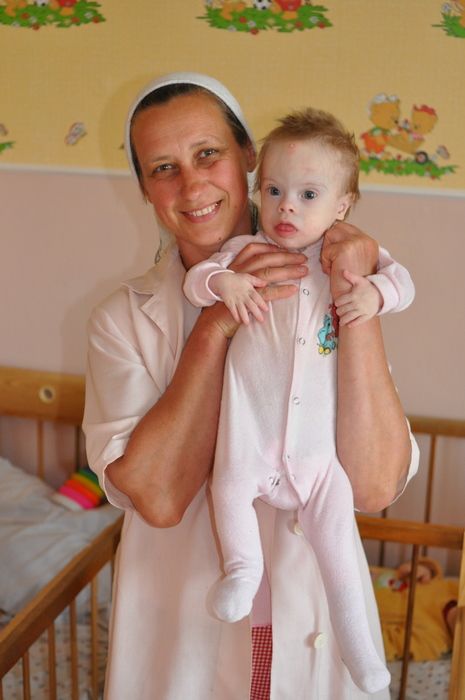
This little boy is Wade. He has Down syndrome, is 3 years old and weighs about 10 lbs. Unbelievable, sickening and sad. He is in the same orphanage that the little girl at the top of this post, Hailee, was just rescued from. In the same room, where the "most needy" children are. Left in their cribs alone. When I saw his picture on this blog post, I couldn't help but cry. This little boy is adorable and he would be a baby I'd adopt right this moment, if adoption wasn't so difficult.
I wish there weren't so many stringent requirements in adoption, because then so many more people could adopt. (Yes, I understand why the requirements are there, but I still think it's a bit over board.)
If little Wade was born into a family who loved him, he would not be 10 lbs at 3 years old. I've seen it with my own eyes. My little brother has Down syndrome and we've loved him and treated him like any other child in our family and he has thrived beyond anything we were ever told! Just simple love goes so far.
Little Wade could do so well in a family and I can only hope that God will open the doors for us to be able to adopt a little guy like him someday.
Sunday, May 23, 2010
Broken Record
Sometimes I feel like I may sound like a broken record, especially when it comes to the plight of the orphans around the world. But, it is something that is very important to me and I will keep talking about.
When my grandparents were here, my grandma was sharing some stories from her childhood. She had a brother who had mental retardation due to something that happened at birth. Back when he was born in the 1930's, America had mental institutions. And it was looked down upon to raise a child like him. Just like it is still in other countries around the world. My grandma's family had a bad stigma around them because her parents raised her brother.
Her mother was encouraged to put him in an institution type of thing when he was an early teen because they would teach him school and he would supposedly do well. Yeah right. She put him in there for a little bit, but hated it. And then ended up bringing him home because he wasn't being taught . . . it was a mental institution.
When my grandmother was telling us this, I couldn't help but think of the orphans who still live the plight of a mental institution and orphanage, even to this day. Yeah, America may not do it anymore and we have come a long ways in that regard, but loads of other countries still do it.
America has just changed what is done with children who have disabilities, namely Trisomies. Instead of putting these children into orphanages or institutions, they are murdered (aborted) 90% of the time a prenatal diagnosis is found. Because many people still are scared of a child who has a disability. And reject the fact, that God is the one who made them with an extra chromosome. There's nothing that the child could do about it anyway!
Instead of being put into a horrible place to live, where there is hardly any love, where they are starved of proper nutrition and adequate food, and basically die a slow death, they are killed as soon as the diagnosis is found out. Except for the 10% of families who choose to keep their baby after they are given the diagnosis.
So, in these other countries around the world, like many Eastern European countries, you can see the children starved and you can see them dieing a slow death until they are rescued through adoption.
This is the reality of the orphanages in many countries:

How old would you say this little girl is? A year old? Give or take a little.
No, she just turned 5 years old. Yes, you read that right . . . F-I-V-E years old. And she weighs 15 lbs. Her family just adopted her and was able to take her out of the orphanage for good this past week. Just in the nick of time before she would be transferred to a mental institution where she would've very likely died quickly. She will now know the love of a family, instead of her small world of living in a crib.

Monday, May 3, 2010
A Mission of Hope
I thought I'd share the article I wrote for our local DSA's monthly newsletter. I can write an article for their newsletter whenever I want, so if anyone has any other ideas for topics, let me know :).
~~~~~~~~~
A Mission of Hope, Truth & Acceptance
My little brother, Osiyyah came into our lives 5 years ago. The day he & his twin sister were born, our lives have been forever changed because of him and the extra chromosome he sports, but it has all been for the better. It has been a huge blessing that God put him into our life.
When he was born, the information and “help” we were offered was so dark & gloomy. It was all this stuff he “wouldn’t” do or how hard our life would be with him. This was in 2005 and as we quickly found out, there is so much that can be done to help children with Down syndrome achieve their highest potential. You would think that we would have been offered all the powerful, helpful resources that are available here in the United States and the potential children with Down syndrome have. Instead of such a dark, “I’m sorry you have a baby with Down syndrome . . . and these are all the things he won’t be able to do.”
Because of this, my mother and I purposed to write a book about Down syndrome at some point to be able to give to families so that they would have access to all the helpful information a lot sooner than we ever did. And so, in the fall of 2008, our book was finished. And appropriately titled, Down Syndrome: What You CAN Do. We edited the book and had resources from all kinds of doctors, therapists, professionals and families put into the book. The introduction was written by Dr. Lawrence Leichtman. The foreword was written by Karen Gaffney. Many other well known therapists, such as Pat Winders and Sara Rosenfeld-Johnson (Talk Tools) also contributed. The book ended up being 589 pages long and full of resources that we wish we would’ve had access to in those first few months after Osiyyah’s birth.
In the United States, families who have a child born with Down syndrome or those who decide to keep their child with Down syndrome because of a prenatal diagnosis, often times hear a very sad, unhopeful picture from their doctor, social worker or whoever the “professional” might be. I have read the stories of those who didn’t get a sad picture when they were given the diagnosis. But, that is not the majority. This same thing happens in European countries, but it’s far worse.
In European countries, nobody knows the multitude of options that are present in today’s society. And so because the government supposedly “knows better”, the majority of these parents leave their infants to live in a orphanages and mental institutions. Most children are in an orphanage until 4-5 years old and then transferred to a mental institution, where the death rate is very high.
These babies & children are tied to cribs or strapped down for hours or even days on end. They are starved of love, adequate care & proper nutrition. Not routinely given baths and treated with hardly any compassion. All because of a special need or extra chromosome they might have. How sad & sickening is that?!
As an example, one family who recently adopted their daughter with Cerebral Palsy from the Ukraine wrote on their blog (http://stumbofamilyadoption.blogspot.com),
"So we asked Nina today about her life at the orphanage, not sure if she understands us, not sure if she knows how to communicate with us.
‘Nina?’ I asked, ‘Were you tied down on your crib? Did you have to lie down and they would tie you?’ She looked at me, a sad expression, her little lip came out, and the tears started to come, she said softly, ‘yes.’ And she cried some more. I held her so close to me, wishing I could take that away from her, wishing that somehow she had not had to go through that. Andy asked her why they did that. ‘Nina naughty, Nina naughty.’ She responded.”
Because of this and the need for proper education and information in these countries, a new off-shoot of Reece’s Rainbow Adoption Ministry called Connecting The Rainbow (CTR) was formed. CTR is a volunteer group that gathers therapy tool donations, book resources and any other helpful material to deliver to the few families who have decided to keep & raise their children with Down syndrome in these European countries.
CTR just took their first trip the beginning of April and brought the 250+lbs of donated items to families in Bulgaria. The small support group in Bulgaria includes 36 children with DS ranging in age from 6 months to 13 years old. These families are going against the grain in their country so much and can use all the help and resources they are given.
We donated a hard copy of one of our books to CTR on Shelley’s first trip to Bulgaria in December. Shelley just completed the adoption of her family’s 3rd child with Down syndrome from Bulgaria. A 7 year old boy from a mental institution. On Shelley’s last trip to Bulgaria in April that included her bringing her son home and the CTR mission trip, we sent 21 CD’s with copies of our book on it to the families in the support group.
Shelley & Leah (CTR) were also able meet with some officials in Serbia in the hopes that a flow of helpful information can be brought there as well. Hopefully the “trend” of orphanages & mental institutions can be stopped. CTR is also working to try to establish connections in Ukraine & Russia. It is all a work in progress and will take a long time. But every family who decides to raise their child with Down syndrome is one less child in the statistic of 147 million orphans worldwide and one less child who will see the abuse & neglect of an orphanage or institution.
Down Syndrome: What You CAN Do can be purchased from http://stores.lulu.com/gotdownsyndrome. A hard copy of the book is $22.73 plus shipping and an e-Book is $5. The book is priced so low because we want it affordable for anyone to get. We did not write a book to make money, we wrote a book to help families.
To see what you can do with Connecting The Rainbow check out their website at www.connectingtherainbow.com. To find out more about internationally adopting children with Down syndrome you can visit Reece’s Rainbow at www.reecesrainbow.com.
~~~~~~~~~~~~
Wednesday, March 24, 2010
Connecting the Rainbow & Our Book
As some of you know, my mother & I published a book about Down syndrome a little over a year ago.
The book, Down Syndrome: What You CAN Do is 589 pages long. My mom & I basically edited it and compiled all the info. Lots of doctors, therapists, parents and families wrote information, articles & stories for the book. Which makes it an excellent resource. Karen Gaffney wrote the foreword. Dr. Lawrence G. Leichtman wrote the introduction. Patricia Winders gave us a physical therapy article to include. Talk Tools & Sara Rosenfeld-Johnson gave us permission to use several articles from them. Just to name a few . . . but lots of other doctors and professionals gave us their time, information & articles.
It took us awhile to compile it together, but it has been well worth it. The book is only $22.73 for a hard copy & $5 for an e-Book. Yeah, I know that is really cheap in price. But, we didn't write this book to make a fortune. We wrote this book so that it will help other families and give families hope to realize there is so much that can be done to help children with Down syndrome.
You can see a 15 page preview of the book and it can be ordered from here.
I have a question for ya'll: Would you guys like to see a hardcover version of our book? Obviously it would be more expensive, but I'm sure there are some who prefer hard cover books over soft covers.
We recently sent International Nutrition several hundred flyers about the book and they also ordered a decent amount to start to provide it on their website. Hopefully they'll have good success with it.
A little side note . . . If anyone would like flyers for their local Down syndrome associations, new parent packets or just to have to give out to whomever, let me know and I'd be glad to mail you some. Our local DS association put a flyer in each of their new parent packets.
Now, all that to bring me to this, the main reason for the post . . . Connecting The Rainbow. I've mentioned CTR before, but thought it would be good to mention it again. We sent a hard copy of our book with Shelley on her first trip to Bulgaria to give to the families there who have chosen to keep their children.
Since that trip, Shelley & CTR has been gathering resources & tools to take to the families in Bulgaria when Shelley returns to bring her son home from Eastern Europe. They have received a great response and gotten a lot of good therapy tools, other tools & resources to take to the families in Bulgaria.
Because of that, I have a stack of 21 CD's sitting here by my computer that have a PDF of our book burned onto them. I'll be mailing them out this week, Lord willing, to Shelley and she'll take them with her on her trip to Bulgaria in April.
Qadoshyah
Tuesday, January 26, 2010
Reece's Rainbow . . .
Reece's Rainbow is an adoption ministry for children with Down syndrome mainly, but also other special needs. They help to bring awareness and find families for the many orphans throughout the world, especially in Eastern Europe. 250 children have found families since Reece's Rainbow started in 2006. Many children have found their families this year and are in the process of being brought home.
The Bedford family is adopting their 3rd child with Down syndrome from Bulgaria. Their two other boys, Xander & Grifyn, came home from the Ukraine & Serbia in 2007 & 2008. You can see their blog here.
Shelley Bedford has a unique opportunity since she is adopting from Bulgaria. She has been able to get in contact with some parents in Bulgaria who have chose to keep & raise their child with Down syndrome. These families are going against the grain big time in their country by raising their children. Now, this may seem strange to some. But, in Eastern Europe (EE) parents are encouraged to give up their "imperfect" children (children with Down syndrome) and let the government raise them in orphanages & institutions. The orphanages & institutions do not give the child their fullest potential. Lack of resources, staff & love creates an environment where these children, who simply have an extra chromosome, do not thrive.
Some orphanages are very poor and the children have malnutrition and are very small. They also typically don't receive the kind of attention & care they need, which hinders them even more. Simply because these children don't have the love of a family, they do not thrive at all. You may have a 4 year old who is only 16lbs. That's not right. But, when these children are brought home to families they THRIVE. The turn around these children make is amazing.
Then you have the mental insitutions, which often times are much worse than the orphanages. The children will spend their day in cribs. Often times tied to their cribs for hours at a time. Even left in their own waste for a long time. Not all institutions are this way, but a lot are. In some EE countries, children are transferred from orphanges at 5 years old and sent to the institutions. Where they may spend just a few short months to a couple years before their death because of neglect & lack of love. Or, they may be there for many years and not be able to be adopted because that specific instition does not allow adoption once the children are transferred there. Thankfully there are some institutions which allow the children there to be adopted.
The boy Shelley is in the process of adopting from in Bulgaria is in an institution. But, he is not in one of the horrible institutions. He is in a place where there is more love & care given to the children.
Because of this opportunity Shelley has been given, a new branch of Reece's Rainbow has been started: Connecting The Rainbow. Connecting the Rainbow was put together to gather resources, therapy items & literature to give to the families in Eastern Europe who have chosen to keep their children. Becaue most people do not choose to keep their children with Down syndrome, the families who do keep their children do not have very many resources. So, Connecting The Rainbow was put together for people to donate items to and then they will be taken to Bulgaria.
So, check out the site and see if you are able to help Connecting the Rainbow in anyway! Shelley will hopefully be returning to Bulgaria in March or April and she hopes to be able to take a lot of supplies with her for the families there.
Qadoshyah
Friday, November 27, 2009
Adoption Awareness Month
November is Adoption Awareness Month. Adoption is something very near & dear to me. If I was able to adopt, I would. But, as of right now it isn't able to happen.
Why is adoption so important? In many countries around the world, Russia, Ukraine, Bulgaria, Serbia, Republic of Georgia, Ethiopia & so many others, children with Down syndrome (& other special needs) are put away into mental institutions. Left to die. It is a horrific & incredibly sad reality. The video below gives a small glimpse into the way many of these children are treated. Not all institutions are as horrible as the one shown in this video, but nonetheless many of the children transferred to mental institutions die within the first year of being there. From sickness, malnutrition, starvation.
Because of this horrible reality, a group called Reece's Rainbow brings awareness and finds homes for many children in orphanages around the world. In the 3 short years it has been in existence, a couple hundred children have found homes.
Due to this fact, a girl named Lydia started a project (the "Darya Project") a week before Thanksgiving to bring one of the children shown on Reece's Rainbow's website home. She set out on a goal to raise $20,000 in 8 days (by Thanksgiving). If she was able to do this, her family would adopt a little girl, Darya, in an orphanage in Eastern Europe. Through bake sales, car washes, photo shoots, and many other things, Lydia was able to raise $26,000 by Thanksgiving morning! As of Friday, the total was $28,500. The extra money is going to another family who has been wanting to adopt a little one with Down syndrome. So, after 8 days of fundraising, 2 children will be rescued out of the orphanages in Eastern Europe.
Qadoshyah
Sunday, November 1, 2009
Silent Auction At "From The Trenches of Adoption"
Valerie & her husband have biological triplets, adopted 2 boys with special needs from 2 different countries within the last couple years. They are now in the process of adopting 3 more children from Bulgaria.
Because the costs of adoption are so high, they are having a silent auction over at their blog From The Trenches of Adoption. There are a lot of nice items available at the silent auction.
As some of you may know, I have a small home business doing graphics & web designing, Country Girl Designs. I donated a Blog Makeover to the Silent Auction.
You can see all the items at this link (just keep scrolling down to see them all). You can see the Blog Makeover at this link.
Feel free to pass on & forward to anyone you know :)!
Qadoshyah
Sunday, February 22, 2009
Why International Adoption . . .
Someone posted this on a DS group I'm on and she gave me permission to post here . . .
Exposing Europe's guilty secret: the incarcerated children of Bulgaria
Views and Records
From The Times
By Rosa Monckton
It is the smell that assaults you - filthy nappies, unwashed babies, rotting
flesh. Then you are hit by the silence, an eerie, unnatural silence, the
silence of babies who have given up hope of ever being consoled, cuddled or
comforted. It is the dreadful quiet of starving, neglected, unloved children
waiting to die.
I was in an institution for children aged three and younger in Bulgaria, and
I found myself crouching beside a cot so that the duty "nurse", who was
three rooms away but who could survey all the rooms through the viewing glass
placed in each dividing wall, was unable to see me. All I could see at this
level were bars stretching all the way to the viewing station, bars imprisoning
these children, whose only crime is to have been born. What sort of a Europe
is it that consigns innocent babies and children to a life like this - a life
bereft of all hope?
The poor child whose cot I was hiding next to had hydrocephalus. His swollen
head was turned to one side, and I could see his brain oozing out of his
skull. The girl in the adjacent cot was so pitifully thin that she looked
flattened, like a cardboard cut-out. The next one along had his legs tied together,
with an old pillow case pulled over them - I felt a huge growth on one of
his spindle-like legs.
The children in this particular wing have no human contact. They are fed
lying on their backs, and have their nappies changed only when there happens to
be a supply of new ones. Not one single word is uttered to them, so none of
them is able to talk. This is how they live, and this is how they die.
Over the past few months I have visited eight institutions in Bulgaria, and
have been staggered by the total lack of humanity. The baby world does not
exist for these children.
Children in Western Europe are institutionalised because of abuse and
neglect, whereas in other parts of Europe, particularly the old communist
countries, it is because of abandonment and disability. In Eastern Europe there is
still a widely held belief that disabled children are best dealt with by being
removed from their families and separated from society.
So the flow of children into the institutional system continues, with many
parents being forced by the State to hand over their children at the moment of
birth if a disability has been diagnosed. Bulgaria has the second-highest
rate of placement of children in institutions in Europe (Russia is top of the
list).
In another institution I was taken around by a blonde Cruella de Vil:
stiletto heels, heavily made-up, clutching a clipboard as we marched along a
corridor. Stopping at each window, she consulted her list, took the pen from behind her ear and pointed: "This one cerebral palsy, this one very handicapped,
this one Down's Syndrome, this one don't know...."
I asked to go into one of the rooms and picked up the nearest child, a
living skeleton. And what was wrong with him? He was blind. Just blind. But now he was starving to death, rocking and banging his head against the side of his
cot. On another visit, I asked the director, a paediatrician, about a child
with Down's Syndrome. Why was she here? "She has Down's Syndrome, she will
die." I told her that this was not true, that these children could live
fulfilled lives. Angered, she asked: "Are you a doctor?" No, I replied, but I was the mother of a child with Down's Syndrome. "But you are not a doctor, so you
don't understand..
born."
I am working with a charity called The Bulgarian Abandoned Children's Trust
and our aim is to re-educate government, doctors, midwives and parents to
bring an end to institutionalisatio
children to move into. Because, unlike Romania, which has made huge progress in the reform of its institutions and has shown that it is ready and willing to
change, Bulgaria remains in denial. The Government sees little need for change.
Nor has it come under the sort of pressure that Romania faced when it was in
discussions to join the European Union and reform of its children's
institutions was a condition of entry.
One of the problems with the old Eastern bloc countries is that where the
State was the guarantor of all moral values, it dehumanised society. The idea
of charity, of social responsibility, of caring for others, was eradicated.
There seems to be no recognition on the part of the carers that they share
something with these children - and that what they share is a common humanity. In homes for the dying in India, you find volunteers serving food, cleaning, or
simply talking to patients 24 hours a day. There is a purpose and a feeling
of life, and hope, in even the most impoverished homes.
The sterility and eerie silence of the Eastern European children's homes is
all the more shocking by contrast. These children are Europe's guilty secret,
hidden away from the world. We need to talk about them, to bring the whole
issue out into the open. We need a co-ordinated European strategy, operating
at the highest levels of government. A tightly run ten-year plan could lead to
many of these shameful places closing their doors. This will need to include
social reform, services in the community, fostering being made an
occupation, easier adoption laws, the building of small-group homes and, most
importantly, more support at birth. More than 96 per cent of institutionalised
children across Europe have at least one living parent. Help is needed to persuade families that they can cope.
It is too late to help many of the children incarcerated in institutions -
their lives are already irreparably damaged. But we can stop the flow of
children into these places. We need early intervention programmes in hospitals and maternity wards; we need to make people care. If you are one of those people who hunts through the supermarket to avoid buying a battery-raised chicken, think for a moment about these children, who are treated no better
Friday, February 20, 2009
If only . . .
On February 11, two little girls died in Eastern Europe from the flu. These little girls had Down syndrome and because of that were put in an institution. Many of the children in Eastern Europe who are born with a diagnosis of Down syndrome, are placed in orphanages and when they turn 5 years old are sent to an institution. The children, once placed in an institution, typically die within the first year of being there. This is a very sad reality and something that happens all the time.
If only the perspective of doctors in these countries would change.
If only the doctors would not tell the parents the "state will do a better job" of raising these children that have something "wrong" with them.
If only parents weren't deceived into thinking these children are such a hardship.
If only countries wouldn't make adoption such an expensive, complicated process, so many more of these "unwanted" children could have families.
If only these children were given love, they would thrive.
But, instead, the children in these orphanages and institutions are left tied to cribs, starved, neglected, shunned, and unloved. They die at a young age and hardly anybody knows. Just like these two little girls below.
Margarita ~
Katarina ~
Qadoshyah
Monday, January 19, 2009
1/18/09 - National Sanctity of Human Life Day
January 18th was the National Sanctity of Human Life Day. The release from the President is below.
This is interesting to note, especially with the incoming president who is anything but pro-life. Obama wants to sign into law the Freedom of Choice Act. FOCA will make all state laws concerning abortion void, including parental consent and much more. It would be just one more horrible law.
National Sanctity of Human Life Day, 2009
A Proclamation by the President of the United States of America
All human life is a gift from our Creator that is sacred, unique, and worthy of protection. On National Sanctity of Human Life Day, our country recognizes that each person, including every person waiting to be born, has a special place and purpose in this world. We also underscore our dedication to heeding this message of conscience by speaking up for the weak and voiceless among us.
The most basic duty of government is to protect the life of the innocent. My Administration has been committed to building a culture of life by vigorously promoting adoption and parental notification laws, opposing Federal funding for abortions overseas, encouraging teen abstinence, and funding crisis pregnancy programs. In 2002, I was honored to sign into law the Born-Alive Infants Protection Act, which extends legal protection to children who survive an abortion attempt. I signed legislation in 2003 to ban the cruel practice of partial-birth abortion, and that law represents our commitment to building a culture of life in America. Also, I was proud to sign the Unborn Victims of Violence Act of 2004, which allows authorities to charge a person who causes death or injury to a child in the womb with a separate offense in addition to any charges relating to the mother.
America is a caring Nation, and our values should guide us as we harness the gifts of science. In our zeal for new treatments and cures, we must never abandon our fundamental morals. We can achieve the great breakthroughs we all seek with reverence for the gift of life.
The sanctity of life is written in the hearts of all men and women. On this day and throughout the year, we aspire to build a society in which every child is welcome in life and protected in law. We also encourage more of our fellow Americans to join our just and noble cause. History tells us that with a cause rooted in our deepest principles and appealing to the best instincts of our citizens, we will prevail.
NOW, THEREFORE, I, GEORGE W. BUSH, President of the United States of America, by virtue of the authority vested in me by the Constitution and laws of the United States, do hereby proclaim January 18, 2009, as National Sanctity of Human Life Day. I call upon all Americans to recognize this day with appropriate ceremonies and to underscore our commitment to respecting and protecting the life and dignity of every human being.
IN WITNESS WHEREOF, I have hereunto set my hand this fifteenth day of January, in the year of our Lord two thousand nine, and of the Independence of the United States of America the two hundred and thirty-third.
GEORGE W. BUSH
